Xieng Khuan · Vientiane, Lao PDR · Est. 1958
Buddha Park
ວັດຊຽງຄວນ · Wat Xieng Khuan
A surreal open-air sanctuary of over 200 colossal sculptures — where Buddhist devotion and Hindu mythology collide in concrete, silence, and mystery.
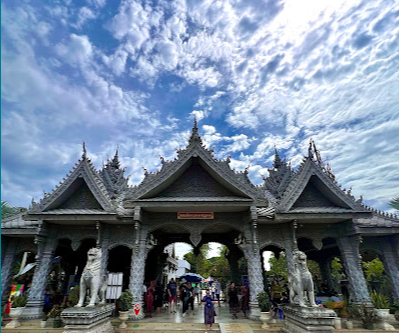 The Sacred Grounds
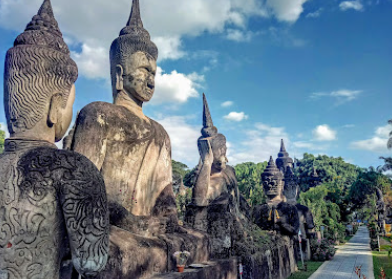 The Reclining Buddha · 40 m
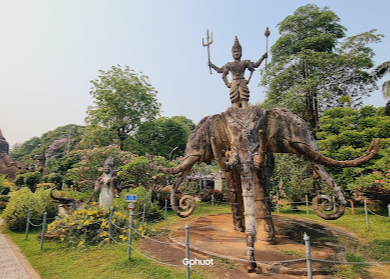 Deities & Demons
The Wonder of Vientiane
Where the Sacred Becomes Strange
If you believe that visiting a temple in Laos means golden ordination halls and conventional Buddha images, then Wat Xieng Khuan — Buddha Park will shatter that assumption permanently. This is an open-air museum of more than 200 religious sculptures, each one strange, awe-inspiring, and saturated in layers of meaning — drawing visitors from around the world who seek an encounter with something they cannot easily describe or forget.
"Every statue here is a question. The park does not give you answers — it gives you silence, and asks you to sit with it."
— On Wat Xieng Khuan, VientianePart I · Origins
Born from Vision & Faith
This is not the work of an institution or a government. It is the lifetime creation of a single extraordinary mind.
1958 CE · The Visionary
Luang Pu Bunleua Sulilat — The Builder
Buddha Park was created in 1958 by Luang Pu Bunleua Sulilat — a deeply devout meditation practitioner and artist who conceived and built every sculpture here not from academic study, but from spiritual vision and faith. He was not merely a sculptor; he was a teacher who chose concrete and steel as his language of dharma.
◆The Concept · Heaven, Earth & Hell
A Park That Teaches Without Words
Wat Xieng Khuan was never intended as a monastery where monks reside. It is a dharma garden — a place where religious teaching is delivered through sculpture alone. What makes it unique is the seamless fusion of Buddhist and Hindu mythology: Buddha figures in every posture stand beside Hindu deities, demons, multi-armed cosmic beings, and characters from ancient literary traditions — all coexisting in one extraordinary landscape.
◇Part II · What to See
Three Wonders Not of This World
The park's power grows with time — the concrete sculptures have aged, cracked, and darkened with moss and weather, making the atmosphere more potent with every passing year.
The Giant Pumpkin — Heaven, Earth & Hell
This is the defining landmark — the image every visitor recognises instantly as Buddha Park. A colossal dome-shaped structure built across three levels according to the cosmological model of Hell, Earth, and Heaven. The entrance is a vast demon's mouth: a dark, narrow opening through which visitors walk to experience the interior chambers (representing the underworld). From there, a steep spiral staircase winds upward through the levels until it emerges at the very top — where a panoramic view of the entire park opens up in every direction. It is the finest photographic vantage point in the park, and one of the most unusual architectural experiences in all of Laos.
The Reclining Buddha — 40 Metres of Stillness
Stretching over 40 metres across the open ground, the reclining Buddha lies in profound repose beneath the open sky. The scale is extraordinary — you must walk its entire length to grasp it. Despite the rough-cast concrete surface, there is a quality of calm authority to the figure that draws both devout worshippers from the surrounding villages and travellers from across the world. It lies surrounded by trees and quietude, making this one of the most meditative spots in the entire park.
Gods, Demons & Cosmic Beings
Throughout the park, the density of sculpture is staggering. Among the most remarkable figures are Vishnu riding Garuda, Indra mounted on the three-headed elephant Erawan, and a series of multi-armed, multi-faced cosmic entities representing the cycle of death and rebirth. Each one has been cast with a level of detail that rewards close inspection — and each carries a specific doctrinal meaning within the syncretic cosmology that Luang Pu Bunleua created here. Walking through the park is like walking through an illustrated scripture, except the illustrations are towering, weathered, and alive with an energy that photographs cannot convey.
Religious Sculptures in the Park
Year of Creation — One Man's Lifetime Vision
Length of the Reclining Buddha
Distance from Central Vientiane
Part III · The Journey
Plan Your Pilgrimage
Wat Xieng Khuan lies 25 kilometres from central Vientiane. Good preparation ensures your visit is worth every moment of the journey.
- Days
- Open Daily
- Hours
- 08:00 – 17:00
- Best morning visit
- 08:30 – 10:00
- Best evening light
- 15:30 – 17:00
Foreign visitors — park entry.
Fees may vary slightly.
Parking fee (self-drive): ~5,000 ₭
Photography throughout the grounds: Permitted.
- Road
- Tha Deua Road
- District
- Hat Sai Fong, Vientiane
- Near
- 1st Thai-Lao Friendship Bridge
- From city centre
- ~25 km
Getting There
Two Ways to Make the Journey
Both options are straightforward. Choose the one that fits your travel style.
Public Bus — Route 14
Bus No. 14 departs from Talat Sao (Morning Market) Bus Station and runs toward the Friendship Bridge, terminating at Wat Xieng Khuan. This is the most affordable option and the one that puts you among local passengers — offering an authentic slice of everyday Vientiane life along the way. Ideal for independent travellers who enjoy the journey as much as the destination.
Tuk-Tuk — Charter from the City
A chartered tuk-tuk from central Vientiane is the most flexible and comfortable option. Always agree the round-trip price before departing — include the return journey in the negotiation. Many drivers will wait at the park while you explore. This is the preferred choice for those carrying camera equipment or visiting with family.
Why It Matters
A World Unlike Any Other
In a world full of beautiful and ornate temples, Wat Xieng Khuan offers something entirely different. It is an encounter with a singular imagination — a walk through a landscape of faith that raises questions about existence, mortality, and liberation with every step. The weathered concrete figures, darkened by decades of rain and sun, have only grown more powerful with age.
If you seek the unexpected — if you want images that look like they belong in another world, and a place that stays in your thoughts long after you have left — Wat Xieng Khuan is the piece that makes your journey to Vientiane complete and unforgettable.